
In this guide (14 sections)
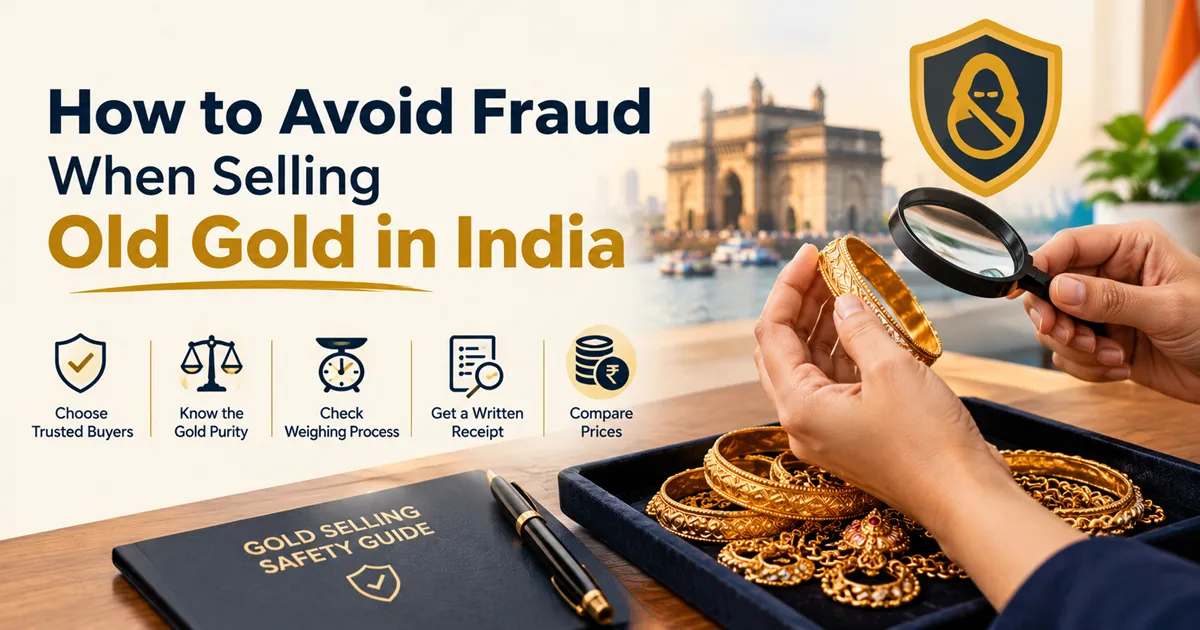
How to Avoid Fraud When Selling Old Gold in India
Selling old gold can help you unlock the value of jewellery you no longer wear. However, the process requires more than finding a buyer and accepting the first offer. Gold purity, net weight, market rates, testing methods, and deductions can all affect the amount you receive.
Whether you plan to sell broken jewellery, inherited ornaments, old gold coins, or unwanted necklaces, you should understand how the valuation works before handing over your gold.
The good news? You do not need to become a gold expert to protect yourself. A few sensible checks can help you avoid common mistakes and recognise warning signs.
This guide explains how to sell old gold safely in India, identify possible fraud, calculate a fair selling price, verify purity, and keep the right records.
1. Understand How Old Gold Selling Works
Before visiting a jeweller or a gold-buying company, understand the three main factors that influence your offer.
- Purity: The amount of gold present in the jewellery.
- Net gold weight: The weight of the gold after accounting for non-gold components, where applicable.
- Applicable gold rate: The rate used for your gold's purity on the day of the transaction.
For example, 22-karat gold contains a higher proportion of gold than 18-karat gold. Therefore, the same weight of these two types of jewellery will not have the same underlying gold value.
Buyers may also apply deductions or different pricing policies. Ask for a clear explanation before agreeing to sell.
If you want to understand the calculation in greater detail, read our guide on how gold price is calculated when selling.
2. How to Avoid Fraud When Selling Old Gold in India
The safest approach is to compare offers, observe the testing process, understand the valuation, and document the transaction.
Choose a buyer with a verifiable business presence
Do not select a gold buyer based only on an attractive advertisement or a promise of the highest price.
Check the business address, contact details, written policies, and customer reviews. Look for consistent business information and a clear explanation of the selling process.
Ask these questions before proceeding:
- How do you test gold purity?
- Will I see the weight and testing results?
- How do you calculate the final offer?
- Do you deduct anything for stones, solder, or other materials?
- Will you provide a receipt showing the transaction details?
- When and how will you make payment?
A professional buyer should explain the process without pressuring you to decide immediately.
You can review Instant Gold Value's services and how the process works before deciding whether the service suits your requirements.
Compare at least two or three offers
One offer does not tell you whether you are receiving a competitive price.
Visit multiple established buyers or obtain comparable quotations. Give each buyer the same information about your jewellery and compare the proposed purity, weight, rate, deductions, and final payable amount.
A higher advertised rate does not always mean a higher payout. One buyer may quote a headline rate but apply larger deductions, while another may offer a lower rate with more transparent pricing.
Compare the final amount you will actually receive.
Never rush because of sales pressure
Be cautious if a buyer claims that an offer will disappear in a few minutes or refuses to let you compare prices.
Gold prices can change, but that does not justify hiding the valuation method or preventing reasonable questions.
Take time to understand the offer. If the buyer becomes aggressive, refuses to explain the calculation, or asks you to hand over jewellery before discussing the terms, walk away.
3. How to Check Gold Purity Before Selling
Purity testing is one of the most important parts of the transaction because it directly affects your jewellery's value.
Check the hallmark and HUID
If your jewellery carries a BIS hallmark, examine the marks and check whether the six-character alphanumeric Hallmark Unique Identification (HUID) code applies to the item.
The Bureau of Indian Standards (BIS) provides the BIS CARE app, which includes a “Verify HUID” feature for checking hallmarked jewellery. You can use it to check the item's recorded hallmark details.
However, a hallmark is not a substitute for understanding the buyer's current valuation. A buyer may still need to assess the jewellery's condition, actual weight, and purity for the transaction.
BIS also confirms that consumers can sell old hallmarked or unhallmarked jewellery to jewellers. An old ornament does not become unsellable simply because it lacks a hallmark. See the official BIS consumer guidance.
Ask how the buyer tests your jewellery
Many gold buyers use an X-ray fluorescence (purity) analyser. This method can estimate the elemental composition of the tested surface without destroying the item.
However, an purity check does not always establish the average purity throughout a piece. Surface composition can differ from the composition inside the jewellery.
BIS explains this limitation in its guidelines for testing old gold jewellery.
Ask the buyer to explain the test results and whether the method supports the conclusion being drawn. Do not assume that a machine display alone proves fraud or guarantees an accurate assessment of every part of a complex ornament.
Get an independent test if you remain uncertain
If a buyer's purity result seems unusually low, pause the transaction.
You can approach a BIS-recognised Assaying and Hallmarking Centre (AHC) to ask about testing your jewellery. BIS provides consumer guidance on testing both hallmarked and unhallmarked articles.
Before agreeing to a test, ask about the method, charges, possible damage, and how the report will identify your jewellery. Some testing methods can damage a sample, so understand the procedure before consenting.
This independent check can help you make a better-informed decision rather than arguing over an unexplained reading.
4. How to Avoid Getting Cheated on Gold Weight
Gold weighing is another area where careful observation matters.
Watch the weighing process
Ask the buyer to weigh your jewellery in front of you. Make sure you can see the scale's display clearly.
Check that the scale reads zero before weighing begins and that the jewellery sits properly on the weighing platform. If the displayed weight changes unexpectedly, ask the buyer to repeat the measurement.
Where practical, get a second weight reading from another reputable buyer. A significant unexplained difference deserves investigation.
India's Legal Metrology framework addresses the accuracy and verification of weighing and measuring instruments used in commercial transactions. The Department of Consumer Affairs explains these requirements on its Legal Metrology overview page.
Understand gross weight and net gold weight
Jewellery may contain stones, beads, enamel, threads, wax, or other non-gold components. The total weight of the ornament may therefore differ from the weight used to value its gold content.
Ask the buyer to show you:
- The total weight of the jewellery.
- Any weight excluded for non-gold components.
- The net weight used in the valuation.
- The purity assigned to the gold.
- The calculation used to arrive at the final offer.
Do not accept a vague statement such as “this is the gold weight” without understanding how the buyer reached that figure.
A difference between gross weight and net gold weight is not automatically a scam. The important question is whether the measurement and deductions are transparent and reasonable.
Be careful with stones and mixed materials
If your jewellery contains gemstones, pearls, or decorative elements, ask whether the buyer removes their weight through a separate measurement or uses another method.
Also ask whether the proposed valuation includes any non-gold components. Never assume that every gram of a jewellery piece will receive the gold rate.
For broken or damaged ornaments, see our page on selling broken gold in Mumbai.
5. How to Calculate Old Gold Selling Price in India
You can estimate your jewellery's gold value before visiting a buyer. This gives you a useful benchmark and helps you question offers that do not make sense.
Use a simple gold valuation formula
If you have the net gold weight and a reference rate for 24-karat gold, you can estimate the metal value using:
Estimated gold value = Net gold weight × 24K reference rate per gram × Purity factor
For a simple karat-based estimate, the purity factor is the karat value divided by 24.
For example, suppose your jewellery contains 10 grams of gold, the reference 24K rate is ₹10,000 per gram, and the assessed purity is 22K.
This is an illustrative calculation, not a current market quotation. The example assumes that the entire 10 grams represents gold-bearing material at the stated purity.
Your actual offer may differ because of the buyer's applicable rate, verified purity, net weight, and any disclosed deductions. Karat-based calculations are estimates; the buyer's documented testing and pricing method should determine the actual valuation.
For a convenient starting point, use the gold value calculator and check the gold rate today in Mumbai.
Check which rate the buyer uses
Do not compare a 22K jewellery offer directly with a 24K reference rate without adjusting for purity.
Ask whether the buyer uses a 24K reference price and calculates the purity factor, or uses a rate already adjusted for the assessed purity.
Otherwise, you could accidentally compare two different pricing methods and draw the wrong conclusion.
Also, distinguish the market value of the gold content from the final amount offered for old jewellery. The retail price of a new ornament may include making charges, taxes, and other costs that you should not automatically expect to recover when selling used jewellery.
Ask for a breakdown of deductions
If the buyer deducts money for stones, non-gold components, refining, or other charges, ask for the amount and reason.
A deduction is not automatically fraudulent. However, unexplained deductions make it difficult to evaluate the offer fairly.
The final calculation should be clear enough for you to reproduce it using the stated weight, purity, rate, and deductions.
6. Common Old Gold Selling Frauds in India
Understanding common warning signs can help you avoid a bad transaction. These examples describe risks to watch for, not claims that every buyer uses such practices.
| Potential warning sign | How to protect yourself |
|---|---|
| The buyer refuses to show the weight | Ask to observe the weighing or leave. |
| The purity result appears without an explanation | Request the test method and result details. |
| The buyer changes the offer after testing | Ask for the revised calculation in writing before deciding. |
| The quoted rate sounds unusually high | Compare the final payable amount with other offers. |
| Deductions appear only at the end | Request a complete breakdown before accepting. |
| The buyer refuses to provide a receipt | Do not complete the transaction without an adequate record. |
| The buyer pressures you to decide immediately | Pause and compare other options. |
| The payment does not match the agreed amount | Verify the payment and resolve the discrepancy before closing the transaction. |
Can a jeweller reduce gold purity during testing?
A test result that differs from your expectation does not, by itself, prove that the buyer manipulated the result.
Purity can vary across an item, and surface-based testing has limitations. However, you should question an unexplained result, especially when it causes a substantial reduction in the offer.
Ask for a repeat test or an independent assessment from a BIS-recognised centre. If you suspect deliberate misconduct, preserve the available evidence and use the appropriate complaint channel.
7. Which Is Safer: A Jeweller, Gold-Buying Company, or Bank?
No category is automatically the safest in every situation. Evaluate the individual provider, the transparency of its process, and the terms of the transaction.
A jeweller: A reputable jeweller may provide a convenient option, especially if you already know the business. Still, ask for a transparent valuation and compare the final offer.
A gold-buying company: A specialist buyer may offer a structured testing and payment process. Check its business details, written policies, fees, and customer feedback rather than relying on its brand name alone.
A bank: Do not assume that a bank will purchase your old household jewellery for cash. Bank services and policies differ, so confirm whether the particular bank offers the transaction you want. A gold loan is not the same as selling gold.
Choose the provider that explains its testing, pricing, deductions, payment, and documentation clearly. Convenience matters, but it should not replace verification.
8. Documents Required to Sell Old Gold in India
The documents a buyer requests may depend on its policies, the transaction, and applicable legal requirements.
A buyer may ask for identity or address verification, purchase records, or other supporting documents. Inherited jewellery may require additional information if ownership is unclear or disputed.
Before visiting, ask the buyer which documents it accepts and why.
Carry only the documents you reasonably need, and avoid sharing sensitive personal information with an unverified business.
For a detailed checklist, read our guide to documents required to sell gold in India.
If you are selling jewellery inherited from a family member, you can also explore our service page for selling inherited gold in Mumbai.
9. What to Check on the Receipt When Selling Gold
A proper transaction record helps you confirm what you sold, how the buyer valued it, and how much you received.
Before leaving, check whether the receipt or written transaction record includes the following details, where applicable:
- Buyer's business name and contact details.
- Transaction date and reference number.
- Description and identification of the jewellery.
- Recorded weight and purity.
- Applicable gold rate and calculation.
- Deductions and the reasons for them.
- Final payable amount.
- Payment method and payment confirmation.
- Any relevant terms you accepted.
Not every business uses an identical receipt format, but the record should clearly document the important commercial terms.
Compare the receipt with the amount actually paid. If a figure differs from the agreed calculation, ask for a correction or explanation before treating the transaction as complete.
Keep a copy of the receipt, payment confirmation, and any valuation report you receive.
10. What Should You Do If a Gold Buyer Cheats You?
If you suspect fraud, act promptly and keep your account of events factual.
Step 1: Preserve your evidence. Keep the receipt, valuation details, payment records, messages, advertisements, and any test reports. Write down what happened while the details remain fresh.
Step 2: Contact the business in writing. Explain the specific discrepancy, attach supporting evidence, and request a clear response or resolution.
Step 3: Seek consumer assistance. India's National Consumer Helpline accepts consumer grievances through its official website, consumerhelpline.gov.in, and toll-free number 1915, available from 8 a.m. to 8 p.m. The helpline can guide consumers through the grievance process, although a particular outcome is not guaranteed.
Step 4: Use the relevant official channel. For a hallmark-related complaint, consult BIS's official complaint information. If you suspect deliberate fraud, coercion, or another potentially criminal act, consider contacting the appropriate police or legal authority.
Do not make public accusations that go beyond the evidence you have. Focus on the transaction records, the discrepancy, and the resolution you are seeking.
11. A Simple Checklist Before Selling Old Gold
Use this checklist before you hand over any jewellery.
- Check the day's relevant gold rate.
- Inspect any hallmark and verify the HUID where applicable.
- Compare at least two or three offers.
- Watch the weighing and purity-testing process.
- Confirm gross weight, net weight, and purity.
- Understand every deduction.
- Calculate the expected value independently.
- Read the final terms and check the receipt.
- Verify the payment before leaving.
- Keep the transaction records.
If you are selling jewellery in Mumbai or the surrounding region, you can explore our pages for selling old gold in Mumbai, Thane, and Navi Mumbai.
You can also read our related guides on selling old gold safely in Mumbai and whether it is safe to sell gold from home.
Conclusion
Selling old gold safely in India comes down to three things: transparent testing, accurate weighing, and a clear price calculation.
Do not rely solely on a buyer's reputation, a hallmark, or an attractive advertised rate. Verify what you can, ask questions about what you cannot, and compare the final amount rather than the headline offer.
A trustworthy transaction should leave you understanding how the buyer valued your jewellery and why you received the amount offered. If anything remains unclear, you can pause the sale and seek a second opinion.
Your old gold has value. Take the time to understand that value before you sell it.
Next steps
Know what a fair offer looks like before you talk to any buyer: see why buyers pay less than the gold rate and which purity test is most accurate. Get a no-obligation estimate on our gold value calculator or book a free home visit across Mumbai, Thane and Navi Mumbai.
FAQs
How can I avoid fraud when selling old gold in India?
Choose a verifiable buyer, compare multiple offers, and observe the weighing and purity-testing process. Ask for the applicable gold rate, net weight, purity result, deductions, and final payable amount. Verify any applicable BIS hallmark using the official BIS CARE app. Before completing the transaction, review the receipt and confirm that the payment matches the agreed amount.
How do I know if a gold buyer is cheating me on purity or weight?
Warning signs include refusing to show the weighing scale, withholding test results, changing the offer without explaining why, or refusing to provide a transaction record. These signs warrant caution but do not independently prove fraud. Request a repeat measurement, ask how the buyer determined purity, and consider an independent assessment at a BIS-recognised Assaying and Hallmarking Centre.
How can I calculate the fair price of my old gold before selling it?
First, establish the net gold weight and assessed purity. Then apply the appropriate gold rate to estimate the metal value. If you start with a 24K reference rate, a simple estimate uses the karat value divided by 24 as the purity factor. Compare the resulting estimate with the buyer's written offer and examine every deduction before accepting.
Can a jeweller reduce the purity of gold during testing?
A purity reading may differ from your expectations because gold composition can vary within an ornament, and surface-based testing has limitations. An unexpected result alone does not prove deliberate manipulation. Ask the jeweller to explain the test, repeat it if appropriate, and consider independent testing. BIS-recognised centres offer consumer testing services, subject to their procedures and applicable charges.
How do I verify gold purity using BIS or a hallmark before selling?
Inspect your jewellery for applicable BIS hallmark details and its HUID, where present. Use the official BIS CARE app's “Verify HUID” feature to check the recorded details of a hallmarked item. Remember that a hallmark records the item's hallmarking information; it does not replace a current valuation. If purity remains disputed, ask a BIS-recognised Assaying and Hallmarking Centre about independent testing.
What are the most common scams when selling old gold in India?
Potential warning signs include unexplained weight differences, unclear purity results, undisclosed deductions, misleading price claims, pressure to sell immediately, and refusal to provide a receipt. Protect yourself by observing the measurement, asking for a breakdown of the offer, and comparing quotations. These precautions help identify questionable practices without assuming that every low offer or valuation difference involves fraud.
Is it safer to sell old gold to a jeweller, a gold-buying company, or a bank?
The safest choice depends on the individual provider and its procedures. Compare the transparency of the purity test, weighing process, pricing method, deductions, payment terms, and documentation. Reputable jewellers and specialist gold buyers may both offer suitable options. Do not assume a bank buys old jewellery for cash; confirm the specific bank's services before visiting.
What documents and receipts should I get when selling old gold in India?
Ask the buyer which identity documents and supporting records it requires before visiting. After the sale, obtain a transaction record showing the buyer's details, date, jewellery description, weight, purity, applicable rate, deductions, final amount, and payment information, where applicable. Keep the receipt, payment confirmation, and any test report. Requirements may vary with the transaction and applicable rules.
Can I sell old gold without a BIS hallmark or original bill?
Yes. BIS confirms that consumers can sell old hallmarked or unhallmarked jewellery to jewellers. However, an individual buyer may request supporting documents or conduct its own purity assessment. Contact the buyer beforehand to confirm its requirements. If the jewellery's ownership is disputed, or it forms part of an inheritance with unresolved legal issues, address those concerns before attempting the sale.
What should I do if a gold buyer cheats me while selling jewellery in India?
Preserve your receipt, test report, payment confirmation, messages, and other evidence. Contact the business in writing and explain the specific discrepancy. You can also approach India's National Consumer Helpline at 1915 or through consumerhelpline.gov.in for grievance assistance. For suspected criminal fraud, consider contacting the appropriate police or legal authority. Keep your complaint factual and retain copies of all supporting records.