
In this guide (12 sections)
You hold a gold chain. Three people test it. You get three slightly different answers. Who do you believe?
That question sits behind every gold sale in India. The short answer: fire assay is the most accurate gold purity test, XRF comes close for most jewellery, and the touchstone and acid test work best as quick screening tools. The longer answer explains why, and it can save you real money.
This guide compares all three methods, explains where each one fails, and shows you how to check whether a test result deserves your trust.
What Gold Purity Means
Gold purity appears in karats or fineness. Pure gold is 24K. A 22K piece carries 91.6% gold, and 18K carries 75%.
Indian hallmarks often show fineness as 22K916, 18K750, or 14K585. The hallmark tells you the claimed purity. The test tells you whether the claim holds up.
Since June 2021, BIS hallmarking has been mandatory for gold jewellery sold in India, covering the categories named in government notifications. That rule helps buyers, but it does not remove the need to understand how testing works, especially when you sell old or unmarked gold.
The Touchstone Test: Old, Simple, and Still Around
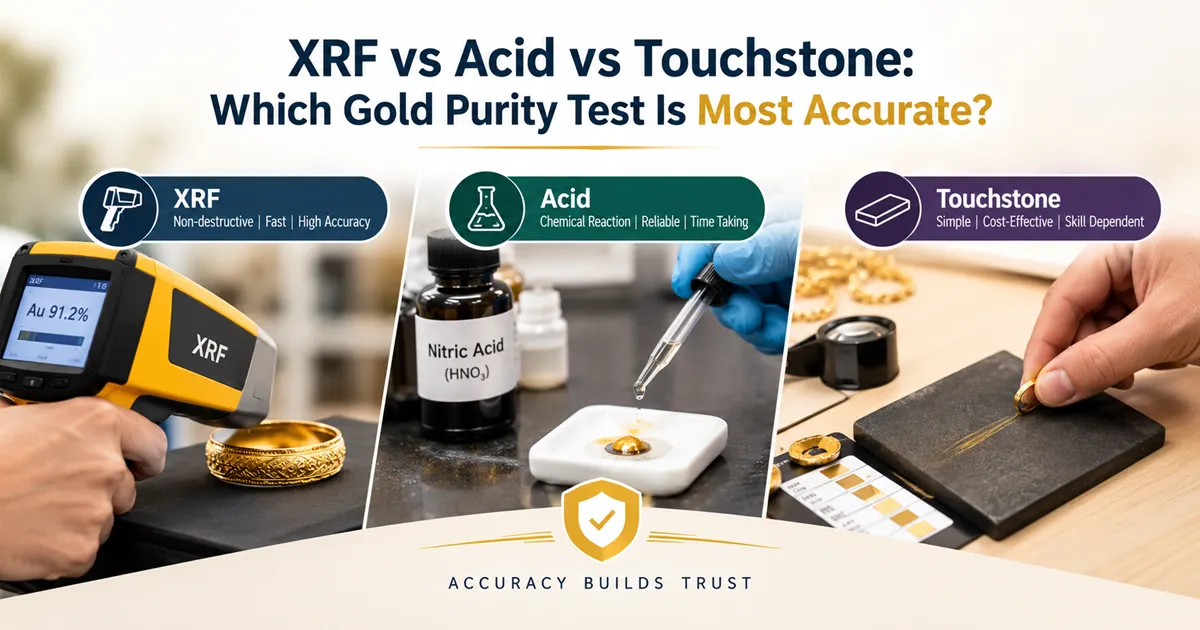
Jewellers in India have used the touchstone for centuries. The tester rubs your gold on a black stone, which leaves a streak. Then the tester compares that streak against streaks from reference needles of known purity.
How Accurate Is the Touchstone Test for Gold?
The touchstone gives a rough purity estimate. An experienced tester can spot a big gap, such as 14K gold passing as 22K. Fine differences, like 21.5K versus 22K, are much harder to call.
Two limits matter most:
- It reads the surface. The streak shows only the outer layer of the piece.
- It depends on the person. Light, stone quality, needle quality, and the tester's eye all change the result.
Think of the touchstone as a smoke alarm. It tells you something may be wrong. It does not tell you the exact problem.
The Acid Test: Fast, but Not Gentle
The acid test adds a drop of testing acid to the streak or the metal. The tester watches how fast the mark changes or dissolves. Lower-karat gold reacts faster than higher-karat gold.
Is the Acid Test Reliable for 22K or 24K Gold?
The acid test is reliable for screening, not for final valuation. Karat-specific acids give a moderate read on solid gold, but they still analyse the surface only. A guide from Londe Jewellers lists the acid test (touchstone) as moderate in accuracy and slightly destructive, because it scratches the surface.
Two more problems appear in real life:
- Plating can fool it. A scratch that cuts through the plating exposes the core, but a light touch may not.
- Acid can mark jewellery. A careless test on a delicate or antique piece can leave a visible spot.
So, can acid testing damage gold jewellery? Yes, it can leave small marks. That is one reason many buyers now prefer non-destructive gold purity testing for finished pieces.
Touchstone vs Acid Test: What Is the Difference?
People often use the two terms together because the methods work as a pair. The touchstone is the surface where you make the mark. The acid is the chemical that reacts with that mark.
| Feature | Touchstone | Acid test |
|---|---|---|
| What it uses | Black stone and reference needles | Testing acids on a mark or scratch |
| What it reads | Colour of the streak | Speed and type of reaction |
| Skill needed | High | Moderate to high |
| Damage to piece | Tiny surface scratch | Possible small mark |
| Best use | Quick screening | Quick screening and rough karat check |
Both methods suit a fast first look. Neither suits a final price on a high-value item.
XRF Testing: The Modern Workhorse
XRF stands for X-ray fluorescence. The machine sends X-rays at the metal, and the metal atoms send back signals unique to each element. The software turns those signals into percentages of gold, silver, copper, zinc, and other metals.
The test takes seconds, and it does not cut or damage your jewellery. That is why BIS-recognised Assaying and Hallmarking Centres (AHCs) commonly use XRF as their primary testing method, according to a guide published by IIFL Finance. The same guide says centres use fire assay when results are borderline, disputed, or need extra confirmation.
How Accurate Is XRF Gold Testing?
On suitable items, XRF is very accurate. Thermo Fisher Scientific, an XRF manufacturer, tested six large, flat gold items against fire assay. Accuracy typically landed within 0.1 to 0.2% of the fire assay result.
Two cautions apply. First, that figure comes from a manufacturer's own test on large, flat items, so treat it as a good sign, not a universal guarantee. Second, accuracy depends on proper calibration and a well-prepared surface.
Can an XRF Machine Give a False Gold Purity Reading?
Yes. XRF reads the surface and a shallow layer below it, so several things can skew the result:
- Plating or coating. If a thick gold layer covers a base metal, the X-rays may never reach the core.
- Uneven composition. Different parts of one item can contain different alloys. Testing several points helps.
- Poor calibration. A machine that nobody calibrates properly will give poor numbers, however expensive it looks.
- Unsuitable items. Thermo Fisher does not recommend portable XRF alone for gold-filled jewellery, gold bars, or bullion. It suggests a second analysis to rule out thick plating or adulteration.
So XRF is excellent, but it is not magic. A good operator tests more than one spot and knows when to ask for a second opinion.
Can XRF Detect Gold Plating?
Often, yes. One manufacturer states that its analyser reads to a depth of 10 to 20 microns, while typical gold plating measures only 1 to 3 microns thick. At that depth, the machine can pick up the base metal under a thin plated layer, such as copper.
Thickness matters, though. A thick coating, a gold-filled item, or a heavily gold-plated bar can still hide the core from the beam. For anything valuable and suspicious, ask for a fire assay.
Fire Assay: The Gold Standard (Yes, Pun Intended)
Fire assay, also called cupellation, has run for thousands of years. A lab takes a small sample, melts it with lead, and lets the base metals absorb into a porous cup. The remaining gold gets parted and weighed.
That process measures the gold itself, not just the surface. It explains why fire assay sits at the top of every accuracy ranking.
What Makes Fire Assay the Most Accurate Method?
Several industry sources describe fire assay as the most accurate technique and the approved method for institutions such as ASTM and ISO. In India, BIS publishes a standard for determining gold by the cupellation (fire assay) method. A Thermo Fisher guide also calls it the legal method for gold hallmarking.
The downside is obvious. It destroys the sample, so labs take a small piece, and the process takes longer and costs more than XRF.
When Should Gold Be Tested Using Fire Assay Instead of XRF?
Choose fire assay when the stakes or the doubts run high:
- Gold bars, bullion, or large coins
- Gold-filled or suspected heavily plated items
- Disputed XRF results between buyer and seller
- High-value lots, where small purity gaps add up to big money
- Refinery settlements and official hallmarking checks
XRF vs Acid Test vs Touchstone vs Fire Assay: Side-by-Side
| Method | Accuracy | Damage | Speed | Best for |
|---|---|---|---|---|
| Touchstone | Low to moderate | Tiny scratch | Fast | Quick screening |
| Acid test | Moderate | Possible small mark | Fast | Rough karat check |
| XRF | High on suitable items | None | Seconds | Jewellery buyers, jewellers, hallmarking centres |
| Fire assay | Highest | Yes (small sample) | Slow | Bullion, disputes, refineries |
Accuracy ratings summarise the sources listed at the end of this article. Real results vary with equipment, calibration, and the tester's skill.
Why Do XRF and Acid Tests Give Different Results?
The two methods measure different things in different ways. XRF analyses the elements and calculates percentages. The acid test judges a chemical reaction by eye.
Several things can widen the gap:
- Surface condition. Dirt, polish, plating, and wear change what each method sees.
- Item design. Hollow pieces, solder joints, and clasps often carry a different alloy from the main body.
- Operator judgment. The acid test depends heavily on human interpretation. XRF depends more on calibration and testing practice.
- Different sampling spots. Each method may touch a different part of the piece.
When results disagree, the answer is not to pick the number you like best. Test again with a more accurate method.
Which Gold Purity Test Is Best for You?
The best method depends on who you are and what you need to decide.
Jewellers: XRF fits daily work, since it is fast and non-destructive. Use a touchstone as a quick backup check.
Gold buyers: XRF gives the best balance of speed and trust. Always test more than one spot, and offer fire assay for large or disputed lots.
Refineries: Fire assay settles the final accounts. It measures the gold content that actually matters.
Everyday sellers: You do not need to run tests yourself. You need to ask the buyer which method they use and to watch the test happen in front of you.
How to Check Whether a Gold Purity Result Is Trustworthy
Use this short checklist before you accept any number:
- Watch the test. Never hand your gold over and wait in another room.
- Ask for the method. A buyer who says "XRF" should be able to explain what it measures.
- Look for multiple readings. One reading on one spot is thin evidence.
- Check the hallmark. A BIS hallmark with a HUID gives you a documented starting point.
- Compare with a second test. Take a high-value piece to a BIS-recognised AHC. More than 1,400 such centres operate across India, according to IIFL Finance.
- Weigh the piece yourself. Purity and weight together decide the payout. Our guide on how gold price is calculated when selling explains the maths.
For a quick estimate before you visit any buyer, try the gold value calculator and check the gold rate today in Mumbai.
How Purity Testing Fits Into Selling Your Gold
Purity decides your price. A gap of just one karat on a heavy necklace can change your payout by thousands of rupees. That is why the testing step deserves your full attention.
If you plan to sell, read these first:
- How to sell old gold safely in Mumbai
- How to avoid fraud when selling old gold in India
- Is it safe to sell gold from home?
- Documents required to sell gold in India
- Tax on selling gold in India
You can also see how the process works on our how it works page, or browse the services we offer. We test in front of you, so you see the reading as it appears. If you want to sell old gold jewellery in Mumbai, broken gold, or gold coins and bars, the right test depends on the item. Coins and bars especially deserve a more careful method than a quick scratch.
Living elsewhere in the region? We serve Andheri, Bandra, Thane, Navi Mumbai, and many more areas listed on our areas we serve page. Questions? Visit our FAQ or contact us.
Final Verdict
Fire assay wins on accuracy. XRF wins on practicality. The touchstone and acid test win on speed and tradition, but lose on precision.
For most people selling jewellery, XRF testing done in front of you, on several spots, gives a reliable result. For bars, bullion, or disputed results, fire assay settles the argument. Whatever method a buyer uses, make sure you can watch it, question it, and compare it.
Related reading
See how XRF testing fits into a home visit, how scrap is tested in our guide to selling broken gold in Mumbai, and how to read the marks on your jewellery in how to read a gold hallmark and HUID. You can get a no-obligation estimate on our gold value calculator or book a free home visit across Mumbai, Thane and Navi Mumbai.
Staying safe when you sell: read how to avoid fraud when selling old gold, whether it is safe to sell gold from home and how to sell old gold safely in Mumbai.
FAQs
Which is more accurate for gold purity testing: XRF, acid test, or touchstone?
XRF is more accurate than the acid test or touchstone for most jewellery. It reads the metal's elemental composition in seconds without damage. The touchstone and acid test judge the surface by eye and by reaction. Fire assay beats all three, so use it for bullion or when results conflict.
Can an XRF machine give a false gold purity reading?
Yes, it can. XRF mainly reads the surface layer, so thick plating, gold-filled items, uneven alloys, or poor calibration can skew results. Good operators test several spots and double-check suspicious items. For bars, bullion, or disputed results, a fire assay gives a more reliable answer.
Can XRF testing detect gold-plated jewellery?
Often it can. XRF analysers read a few micrometres into the metal, and typical gold plating is very thin, so the machine can detect the base metal underneath, such as copper. Thick plating or gold-filled pieces can still hide the core. Ask for a fire assay if you doubt a valuable item.
Is the traditional acid test reliable for checking 22K or 24K gold?
The acid test works as a screening tool, not a final verdict. It checks the surface only and depends on the tester's judgment. It can separate obvious low-karat gold from high-karat gold, but it struggles with small differences and plated items. Confirm important results with XRF or fire assay.
What is the difference between touchstone testing and acid testing for gold?
The touchstone is a black stone where the tester rubs gold to leave a streak and compares its colour with reference needles. The acid test adds testing acid to that streak and watches the reaction. Testers often use both together. Both methods check the surface and rely on human judgment.
What is the most accurate way to test gold purity without damaging jewelry?
XRF is the most accurate non-destructive method for gold purity. It analyses the metal composition with X-rays, takes seconds, and leaves the piece untouched. Accuracy depends on calibration and testing several spots. Fire assay is more accurate still, but it needs a small destroyed sample.
When should gold be tested using fire assay instead of XRF?
Choose fire assay for gold bars, bullion, gold-filled items, high-value lots, or disputed XRF results. BIS-recognised hallmarking centres also use fire assay when XRF results look borderline or need confirmation. Fire assay takes longer and removes a small sample, but it measures gold content directly.
Why can XRF and acid tests give different gold purity results?
The two methods measure different things. XRF calculates the percentage of each element, while the acid test judges a chemical reaction by eye. Plating, solder joints, surface wear, different test spots, and tester skill all widen the gap. When results disagree, use a more accurate method to settle it.
How can I verify whether a gold purity test result is trustworthy?
Watch the test yourself, ask which method the buyer uses, and request readings from several spots. Check for a BIS hallmark with a HUID, and compare the result with a second test for high-value items. A BIS-recognised Assaying and Hallmarking Centre gives an independent opinion.
Which gold purity testing method is best for jewelers, gold buyers, and refineries?
Jewellers and gold buyers usually get the best balance from XRF, since it is fast, non-destructive, and accurate on most jewellery. Refineries rely on fire assay for final settlement because it measures gold content most precisely. A touchstone helps as a quick backup screen for any of them.